Start with the application
A useful valve request begins with the engine and the job it needs to do. Identify the engine and cylinder-head version, whether the valve is intake or exhaust, and the intended use. Include the supporting build information your engine builder has confirmed rather than relying on an engine name alone.
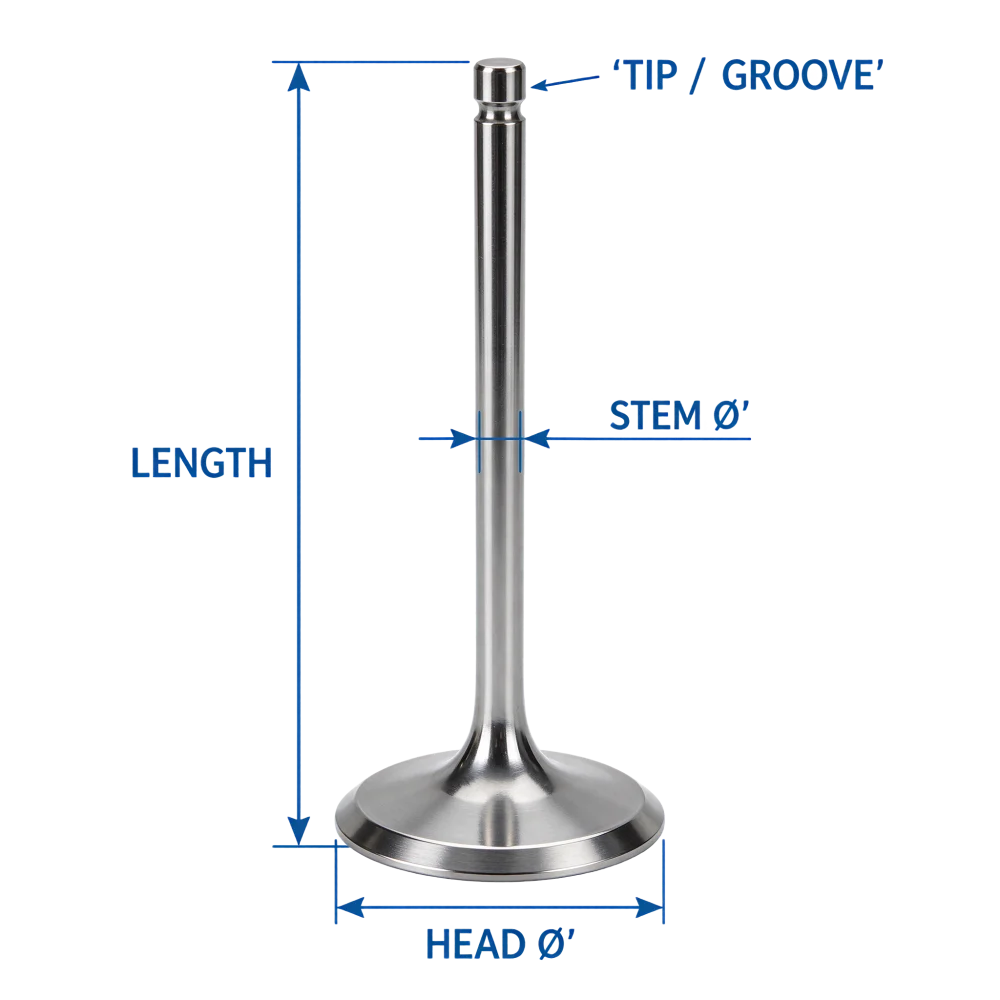
Supertech’s custom valve form asks for valve type, material, overall length, tip length, head diameter, stem diameter, and groove type. Those fields are the basis of this guide. They are a specification brief, not a substitute for a complete engineering drawing or installation instructions.
Record the dimensions clearly
Overall length describes the valve from its tip to its head. Tip length concerns the end of the valve above the keeper-groove area. Head diameter is the diameter of the valve head, while stem diameter describes the shaft that runs in the guide. These dimensions describe different parts of the component and should not be used interchangeably.
Use one measurement system throughout the request and label every value with its unit. Have your builder or machinist confirm the dimensions and the measurement reference points. If a value is unknown, identify it as something to confirm rather than estimating a dimension that could affect fitment.
Match the groove and material
The form offers single- and triple-groove choices. The valve groove must be compatible with the intended keepers and retainer arrangement; choosing the head diameter alone does not establish that compatibility.
Material and surface treatment also belong in the discussion. The form lists titanium, Inconel, and black-nitride options. Black nitride describes a surface treatment, so ask Supertech to confirm the underlying material and the correct option for your application. Do not assume that one material choice is appropriate for every intake or exhaust valve.
Confirm the combination before ordering
Add quantity, your contact information, and any relevant drawing or build notes to the specification brief. Your builder should separately check guide fit, seat geometry, piston-to-valve clearance, and the spring and retainer combination against the intended camshaft and operating conditions.
This educational guide explains the Supertech custom valve form linked below. It deliberately provides no universal dimension, clearance, spring pressure, or machining setting. Final specifications, feasibility, pricing, and timing must be confirmed with Supertech before a custom order is placed.
Source & context
The original perspective.
Review the supporting source for the original context behind this guide.
Supertech Performance / Custom valve specification form